

  • Image

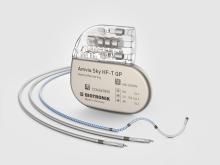
Acticor Sky Family

Reach for A New Standard in Cardiac Care.

Acticor Sky merges more physiologic, less intrusive forms of therapy with intelligent technology to facilitate a new standard of care for your patients.

Current Device Models in the US:

  • Acticor Sky VR-T DX
  • Acticor Sky HF-T
  • Acticor Sky HF-T QP

Category

Tachycardia ICD Cardiac Resynchronization CRT-D

Product Highlights

Image

Physiology-Driven Therapy

Technology that works with the patient’s natural physiology — adaptive, synchronized and less intrusive

Image

Simplified Patient Care

Solutions that meet you in the real world – clearer insights, easier workflows and 24/7 MRI readiness.

Physiology-Driven Therapy

  • LBBAP Support: Easy Programming, Clear Documentation
  • Closed Loop Stimulation (CLS): Giving Control Back to the Patient's Autonomic Nervous System
  • DX Technology: True Atrial Sensing in a Single-Lead ICD System
  • ATP Suite: Advancing Painless Therapy

LBBAP Support

Programming LBBAP in Just a Few Clicks

  • Automatic programming of LBBAP pacing parameters and capture control via predefined program sets
  • Easy recognition of LBBAP patients and clear documentation to maintain accurate interpretation of device data
    • LBBAP Tagging
    • Lead Tip Location
    • LBBAP Capture Type Documentation
  • LBBAP combinable with AVadapt
    • Automatically optimizing AV timing every 60 seconds

Closed Loop Stimulation

Giving Control Back to the Patient's Autonomic Nervous System

  • Physiologic heart rate modulation: Mimics the natural sinus node function by responding to ANS signals1
  • Fully automatic and patient-individualized: Responds to changes in metabolic demand on a beat-by-beat basis1
  • Clinically relevant outcomes: Reduces atrial burden to slow AF progression2

DX Technology

No Unnecessary Burden

DX Technology provides a less invasive, more physiological alternative

  • Dual-chamber-level AF detection without an atrial lead3
  • Shortens procedure time4
  • Reduces complication risk5
  • Available for CRT patients

Atrial lead upgrade is rare, typically ranging between 0 and 2%3,5,14-17 

ATP Suite

Advancing Painless Therapy

Early ATP One Shot aims to painlessly terminate fast VTs early, sparing patients the potential distress associated with ICD shock therapy. 

Based on CERTITUDE real-world data, Mullane et al.6 evaluated over 8,000 ventricular fibrillation (VF) episodes. In patients programmed with Early ATP One Shot, more episodes were terminated painlessly - without a shock.

Acticor Sky further promotes painless therapy by offering three different modes for ATP One Shot in the VF zone:

  • Regular: ATP is delivered after long detection (30/40) before shock
  • Early: ATP is delivered immediately after short detection (12/16) using the long detection for the shock.
  • Adaptive: Early ATP as first attempt. If stability criteria are not met, automatically retrying ATP as Regular - just before charging capacitors

Simplified Patient Care

  • HeartInsight: Maximize Your Efficiency with an All-in-One Alert
  • MRI Guard 24/7: Efficient, Automated MRI Access
  • Same-Day Discharge: More Options in Remote Interrogation
  • CRT AutoAdapt: Automatic, Continuous CRT Optimization

HeartInsight

Maximize Your Efficiency with an All-in-One Alert

HeartInsight shifts heart failure management from detection to prediction

  • One Actionable Alert: for identifying patients at higher risk of worsening heart failure
  • One Engaging Patient App: for collecting self-assessment information relevant to heart failure
  • One Insightful Dashboard: for supporting confident decision making
  • One Step Ahead: for initiating a meaningful change

MRI Guard 24/7

MRI Workflow: Efficiency is Key

  • No pre- and post-scan programming appointments needed7,8
  • Streamlined and automated for both care teams and patients
  • Reduces waiting time by up to 48%9

With MRI Guard 24/7, both 1.5T and 3T machines can be used with 100% full-body MRI scans allowed.

Same-Day Discharge

Reducing Hospital Stay Length Can Reduce Cost

Same-day CIED discharge has shown savings of more than $4,000 per patient10 with no difference in complications, readmission rates or mortality.11,12

EarlyCheck provides remote follow-up two hours post-implant, supporting efficient workflows and potentially reducing additional waiting time.8

QuickCheck provides data within minutes upon a clinician's request in BIOTRONIK Home Monitoring.8

CRT AutoAdapt

Automatic CRT Optimization for a More Personalized Response

  • Timing optimization with focus on clinically relevant AV timing
  • Automatically adjusts the pacing chamber selection, reducing RV pacing when not necessary

CRT AutoAdapt Matches Echo-guided CRT Optimization13

  • Similar AV delay
  • Similar acute hemodynamic outcomes (AoVTI, LVEF, and QRS width)
  • Significantly better than standard programming

Contact us

I agree to receive exclusive information about BIOTRONIK’s upcoming new product family.
country

References:

  1. Malinowski K. Interindividual comparison of different sensor principles for rate adaptive pacing. Pacing Clin Electrophysiol. 1998 Nov;21(11 Pt 2):2209-13. doi: 10.1111/j.1540-8159.1998.tb01154.x
  2. Zecchi P, Bellocci F, Ravazzi AP, Diotallevi P, Audoglio R. Closed loop stimulation: a new philosophy of pacing. Prog Biomed Res. 2000;5(2):126–131. 
    doi: n/a
  3. Mitacchione G, Curnis A, Celentano E, et al. New-Onset Device-Detected Atrial Fibrillation in Patients With Atrial Floating Dipole Implantable Cardioverter-Defibrillators: A Propensity Score-Matched Comparison With Conventional Dual-Chamber Systems. J Cardiovasc Electrophysiol. 2025 Jun;36(6):1303-1313. doi: 10.1111/jce.16666
  4. Sticherling C, Zabel M, Spencker S, Meyerfeldt U, Eckardt L, Behrens S, Niehaus M; ADRIA Investigators. Comparison of a novel, single-lead atrial sensing system with a dual-chamber implantable cardioverter-defibrillator system in patients without antibradycardia pacing indications: results of a randomized study. Circ Arrhythm Electrophysiol. 2011 Feb;4(1):56-63. doi: 10.1161/CIRCEP.110.958397
  5. Shaik NA, Drucker M, Pierce C, et al. Novel two-lead cardiac resynchronization therapy system provides equivalent CRT responses with less complications than a conventional three-lead system: Results from the QP ExCELs lead registry. J Cardiovasc Electrophysiol. 2020 Jul;31(7):1784-1792. doi: 10.1111/jce.14552
  6. Mullane S, Harrell C, Kutyifa V, Di Biase L, Madhavan M, Upadhyay GA, Cheung JW. Early is on time: Minimizing implantable cardioverter-defibrillator shocks through expedited antitachycardia pacing. Heart Rhythm O2. 2025 Aug 6;6(11):1722-1724. doi: 10.1016/j.hroo.2025.07.023
  7. Mullane S, Michaelis K, Henrikson C, Iwai S, Miller C, Harrell C, Hayes D. Utilization and programming of an automatic MRI recognition feature for cardiac rhythm management devices. Heart Rhythm O2. 2021 Mar 9;2(2):132-137. doi: 10.1016/j.hroo.2021.03.002
  8. Data on file
  9. Basquill O, Roy S, McKee B, Moore H, Yang Q, Edwards R, Furniss G. Magnetic resonance imaging in patients with cardiac implanted electronic devices: impact of an automatic MRI programming function on patient wait times and outcomes. Europace. 2025 May;27(Suppl 1):euaf085.633. doi: 10.1093/europace/euaf085.633
  10. Martin DO, Lemke B, Birnie D, Krum H, Lee KL, Aonuma K, Gasparini M, Starling RC, Milasinovic G, Rogers T, Sambelashvili A, Gorcsan J 3rd, Houmsse M; Adaptive CRT Study Investigators. Investigation of a novel algorithm for synchronized left-ventricular pacing and ambulatory optimization of cardiac resynchronization therapy: results of the adaptive CRT trial. Heart Rhythm. 2012 Nov;9(11):1807-14. doi: 10.1016/j.hrthm.2012.07.009
  11. Choudhuri I, Desai D, Walburg J, August P, Keller SI, Suri R. Feasibility of early discharge after implantable cardioverter-defibrillator procedures. J Cardiovasc Electrophysiol. 2012 Oct;23(10):1123-9. doi: 10.1111/j.1540-8167.2012.02367.x
  12. Peplow J, Randall E, Campbell-Cole C, Kamdar R, Petzer E, Dhillon P, Murgatroyd F, Scott PA. Day-case device implantation-A prospective single-center experience including patient satisfaction data. Pacing Clin Electrophysiol. 2018 May;41(5):546-552. doi: 10.1111/pace.13324
  13. Garcia-Fernandez FJ, Ando K, Kato R, Martínez JG, Berruezo A, Jimenez J, Anneken L, Hironobe N, Harada M, Yagishita A, Osca-Asensi J, Mitkowski P, Hayashi H, Kishihara J, Pardo-Fresno M, Ebrahim I, Meyhöfer J, Salguero-Bodes R, Marques P, Moreno A, Pinart M, Bulava A. Acute hemodynamic effects of a novel algorithm for cardiac resynchronization therapy optimization: results from the BIO|Adapt study. Heart Rhythm O2. 2026;0(0). doi: 10.1016/j.hroo.2026.01.030
  14. Thomas G, Choi DY, Doppalapudi H, Richards M, Iwai S, Daoud EG, Houmsse M, Kanagasundram AN, Mainigi SK, Lubitz SA, Cheung JW. Subclinical atrial fibrillation detection with a floating atrial sensing dipole in single lead implantable cardioverter-defibrillator systems: Results of the SENSE trial. J Cardiovasc Electrophysiol. 2019 Oct;30(10):1994-2001. doi: 10.1111/jce.14081
  15. Biffi M, Massaro G, Candelora A, Angeletti A, Valzania C, Martignani C, Grassini D, Diemberger I, Ziacchi M. Less is more: Can we achieve cardiac resynchronization with 2 leads only? Int J Cardiol. 2017 Dec 15;249:184-190. doi: 10.1016/j.ijcard.2017.09.189
  16. Kolb C, Zima E, Arnold M, et al. Clinical performance and safety of a two-lead cardiac resynchronization therapy system with a floating atrial sensing dipole, EP Europace, Volume 26, Issue Supplement_1, May 2024, euae102.367. doi: 10.1093/europace/euae102.367
  17. Mullane S, Salehi B, Harrell C, Kutyifa V, Miller, C. PO-688-04 Low right atrial pacing usage in cardiac resynchronization therapy population – Descriptive study from the CERTITUDE registry. Heart Rhythm. 2022:19(5, Suppl), S389. doi: 10.1016/j.hrthm.2022.03.573